- Incinerator
- Waste Gas Treatment
- Environmental Monitoring

- Product Details
Single Alkali Method Desulfurization (DeSOx)
Technology Introduction
Single alkali desulfurization adopts a single alkaline solution of sodium hydroxide (caustic soda) or sodium carbonate (soda ash) as the desulfurization absorbent. The absorbent fully contacts flue gas in countercurrent mode inside the washing tower. Acidic pollutants such as sulfur dioxide and sulfur trioxide in flue gas undergo acid-base neutralization reactions with the alkaline liquid to realize flue gas desulfurization. After simple sedimentation treatment, part of the spent desulfurization liquid is recycled for circulating spraying in the absorption tower, while a small amount of waste liquid is discharged for disposal.
This process is applicable to projects with low flue gas volume and low sulfur working conditions including medium and small oil-fired and gas-fired boilers, ceramic kilns, glass kilns and small non-ferrous metal smelting furnaces, especially sites with limited space where limestone-gypsum wet process and spray drying process are not suitable.
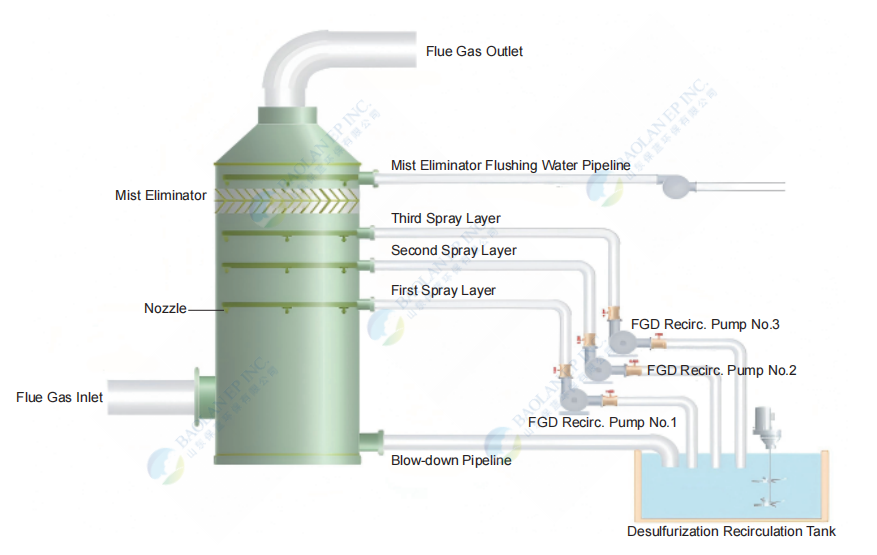
Working Principle
Single alkali desulfurization (usually sodium alkali method using NaOH and Na2CO3 as absorbents) removes acidic pollutants by reacting alkaline absorbent with SO2 in flue gas. It is suitable for the treatment of medium and low-sulfur flue gas.
Main Chemical Reactions (Taking NaOH as the initial absorbent)
1.Absorption Reaction in the Tower (Core Reaction Zone)
Step 1: SO2 reacts with water to form sulfurous acid
SO2+H2 O==H2SO3
Step 2: Sulfurous acid reacts with NaOH to form sodium sulfite (main reaction)
H2 SO3 +2NaOH=Na2 SO3 +2H2 O
Step 3: If SO2 is in excess, sodium bisulfite is formed
H2 SO3 +Na2SO3 =2NaHSO3
Get A Quote

Environ.Trouble
Baolan Trustable
Copyright © 2014-2025 BAOLAN EP INC.