- Incinerator
- Waste Gas Treatment
- Environmental Monitoring

- Product Details
Semi-dry DeSOx
Technology Introduction
Semi-dry DeSOx, full name as Semi-dry Flue Gas Desulfurization Technology, is an efficient and environmentally friendly flue gas treatment technology between dry and wet desulfurization. It is widely used in flue gas desulfurization projects in power, metallurgy, chemical, building materials and other industries. Its core function is to remove sulfur oxides such as sulfur dioxide (SO2) from flue gas, meeting the requirements of industrial emission reduction and environmental protection compliance.
This technology uses lime milk, hydrated lime slurry and other absorbents. The absorbents are sprayed into the desulfurization reactor through a special atomization device to fully contact and mix with high-temperature dust-containing flue gas. During the process, the absorbents react chemically with SO2 in the flue gas to form stable sulfate products. At the same time, the high temperature of the flue gas makes the moisture in the absorbents evaporate quickly, and finally semi-dry desulfurization ash is formed. It does not require a large amount of water resources or produce a large amount of desulfurization wastewater, fundamentally solving the wastewater treatment problem of wet desulfurization.
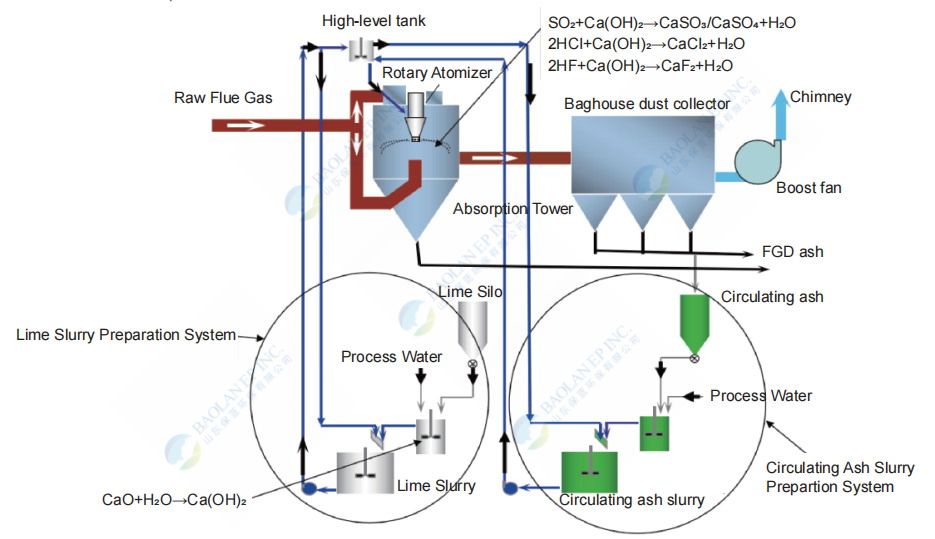
Working Principle
The core principle relies on the contact between atomized alkaline slurry and high-temperature flue gas to achieve rapid evaporation and drying, as well as gas-liquid-solid three-phase acid-base neutralization. Acidic sulfur oxides in the flue gas are converted into solid salts.No large amount of wastewater is generated during the whole process, and the desulfurization efficiency can reach over 95%.
This technology is suitable for treating medium and high-temperature flue gas (140~220℃) from utility boilers, industrial kilns, etc., and is one of the mainstream desulfurization processes besides wet desulfurization.
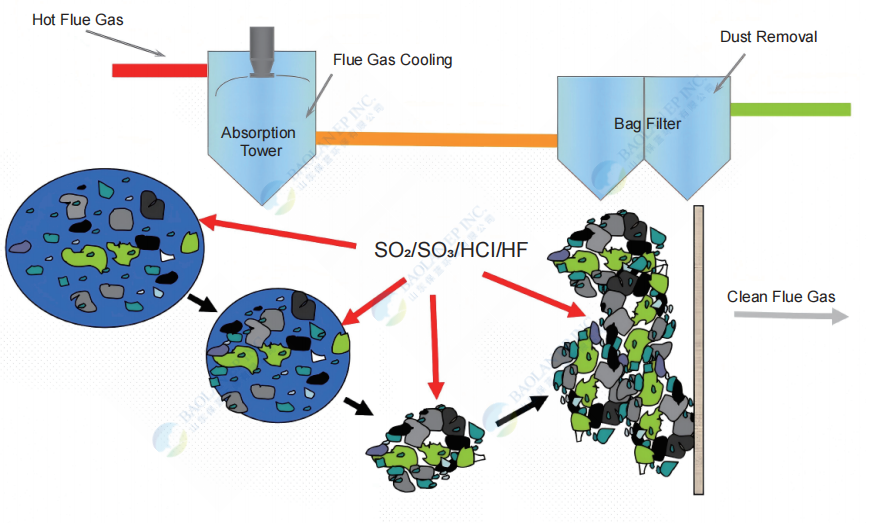
It can simultaneously remove a small amount of SO3, HCl and HF in the flue gas (common in waste incineration/kiln flue gas), realizing multi-pollutant synergistic control.
All reaction products are solid powders, which are collected by the dust collector together with the main desulfurization products.
Removal of sulfur trioxide (forming calcium sulfate dihydrate):
Ca(OH)2 + SO3 + H2O = CaSO4·2H2O↓
Removal of hydrogen chloride (forming calcium chloride, soluble in water but solidified upon droplet drying):
Ca(OH)2 + 2HCl = CaCl2 + 2H2O
Internal Structrue
Absorber System:Flue gas enters the absorption tower through the original flue duct in two upper and lower paths. When these untreated hot flue gases are dispersed into the spray drying absorption chamber, they come into contact with finely atomized lime slurry droplets with an average diameter of 60μm.
During the gas-liquid contact process, the acidic components (such as SO2) in the flue gas are quickly absorbed by the alkaline droplets, and the moisture is rapidly evaporated simultaneously.
By controlling gas distribution, slurry flow rate, droplet diameter, and other parameters, the droplets involved in the absorption reaction are ensured to dry before reaching the wall of the spray drying absorption chamber, ultimately forming powdery desulfurization products (mainly calcium sulfite).
The treated flue gas enters the bag filter for dust removal, where suspended particulate matter is removed. The purified gas is then drawn out of the filter by the booster fan and directly discharged.
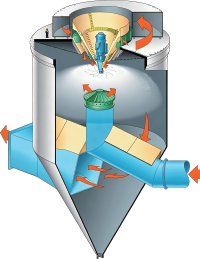
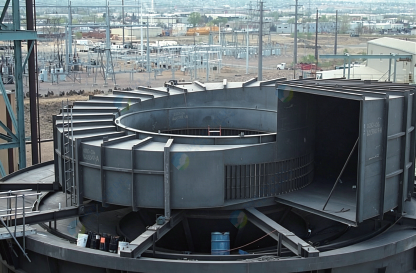
Central Gas Distributor:The central gas distributor is located in the middle of the absorber and consists of an inlet duct and outlet guide vanes. The injected flue gas flow rotates slightly counterclockwise. Flue gas enters from both the upper and lower sections, ensuring thorough mixing between the flue gas and the sprayer slurry to achieve a high acid gas removal efficiency.
A baffle is installed in the horizontal inlet duct of the central distributor to prevent dust deposition.
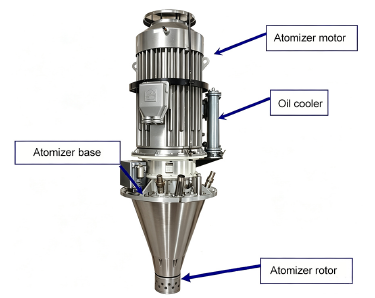
The rotary atomizer is the core equipment of the entire SDA process and a patented product of Niro. It atomizes the slurry into extremely fine droplets by centrifugal force generated through high-speed rotation. The droplets react with high-temperature drying flue gas, and the product is fly ash.
The high-level tank is responsible for supplying slurry to the rotary atomizer and forming a slurry circulation loop
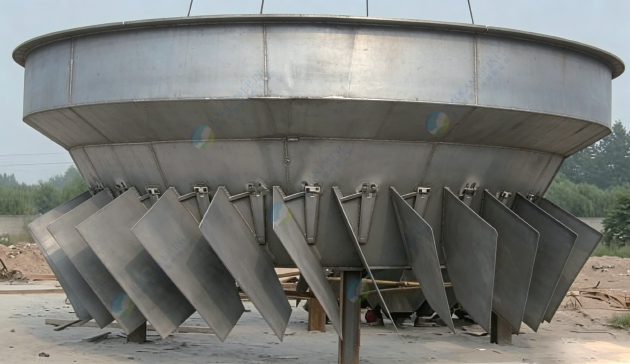
Gas Atomizer Description:When the solid concentration in the lime slurry droplets reaches a specified level, it is beneficial to the operation of the SDA system and ensures effective atomization, absorption, and drying in the flue gas desulfurization (FGD) system.
Excess lime in the dried product can be reused as absorbent. Even if the reaction products do not react further, they form nuclei inside each lime slurry droplet. New absorbent continuously deposits on these nuclei, increasing the lime surface area available for reaction with untreated flue gas.
Engineering experience shows that recycling the desulfurization residue can reduce reagent consumption by 30–50%, significantly
reducing the operating cost of desulfurization.
Introduction to the Pneumatic Ash Conveying System:The pneumatic ash conveying system consists of the fly ash handling system of the bag filter, the ash bin unloading and venting system, the ash silo aeration air system, and the silo bottom unloading system.
Using compressed air as the power source, the fly ash is conveyed to the circulating ash silo or ash silo through closed pipelines installed on the bin pumps. The circulating ash can be recycled and reused, while the desulfurization ash is discharged externally through the ash silo bottom unloader, bulk loader, and double-shaft mixer, realizing pollution-free ash discharge.
Get A Quote

Environ.Trouble
Baolan Trustable
Copyright © 2014-2025 BAOLAN EP INC.