
- Product Details
Technology Introduction
Our VOCs catalysts use multiple metals as active components and adopt special preparation processes to uniformly disperse the metal components on the carrier surface. They do not shed powder or fall off and can be used for catalytic decomposition of VOCs gases. These catalysts feature high catalytic efficiency, a wide operating temperature range, and good stability. The VOCs catalyst series is divided into rare metal catalysts and precious metal catalysts, allowing users to choose according to their needs.
Technology Comparison
Technical | Rare Metal Catalyst | Precious Metal Catalyst- 200 | Precious Metal Catalyst- 300 | Precious Metal Catalyst- 400 |
Active Components | Sc, La, Ce, Pr, etc. | Precious metals such as Pt, Pd, Au | Precious metals such as Pt, Pd, Au | Precious metals such as Pt, Pd, Au |
Service life | 1-3 years | 1-3 years | 1-3 years | 1-3 years |
Advantages: | Polymetallic compound, certain sulfur chlorine resistance Performance, low cost, and wide use | Precious metal components, high efficiency, and rotation Low chemical temperature and low operating cost | Precious metal components, high efficiency, and rotation Low chemical temperature and low operating cost | Precious metal components, high efficiency, and rotationLow chemical temperature and low operating cost |
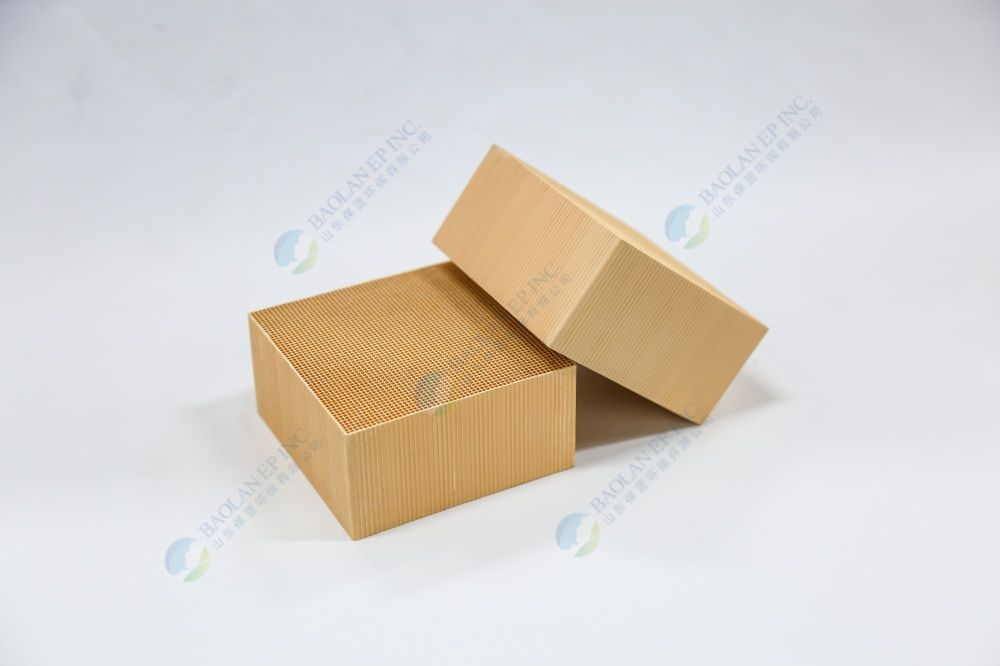
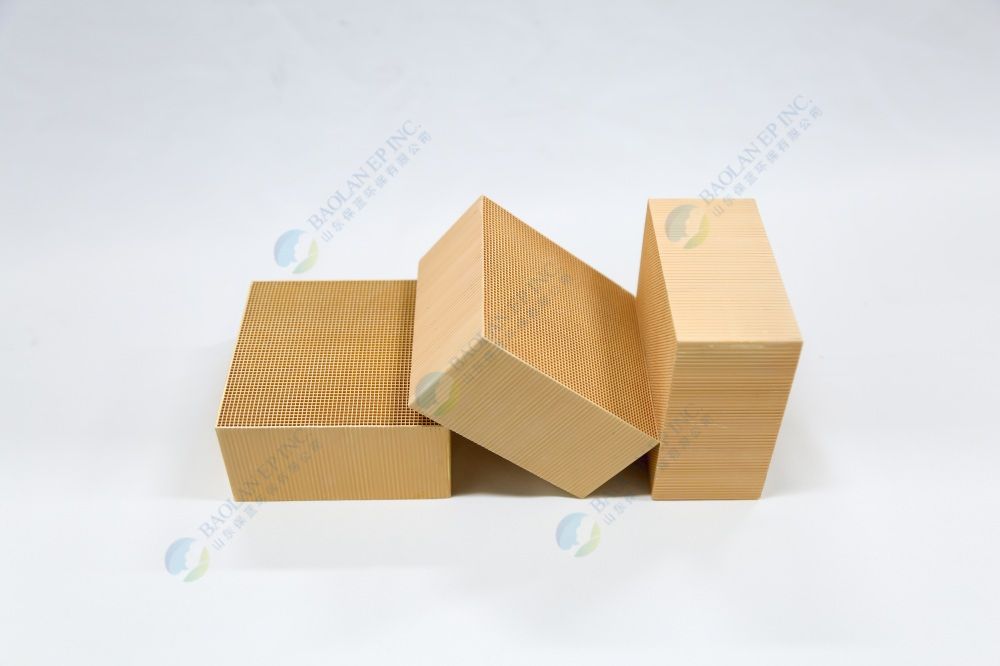
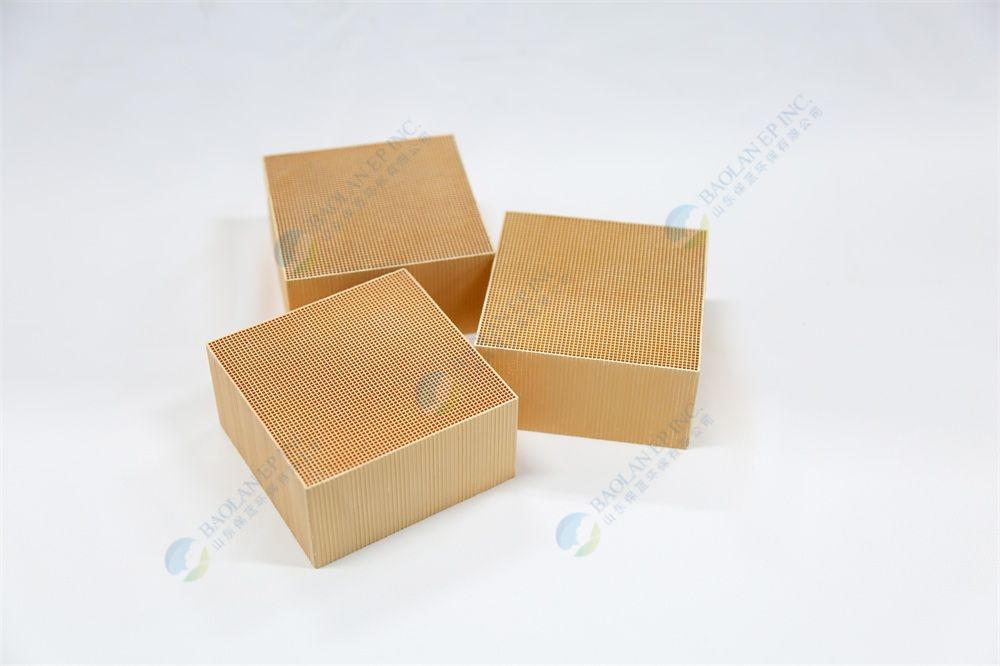
Shape | Square honeycomb, deepblack | Square honeycomb,light yellow | Square beeNest, lightyellow | Square honeycomb,light yellow |
Carrier | Honeycomb Ceramic | Honeycomb Ceramic | Honeycomb Ceramic | Honeycomb Ceramic |
Hole Type and Density | Square Hole, 200 CPSI | Square Hole, 200 CPSI | Square Hole, 200 CPSI | Square Hole, 200 CPSI |
Length Width Height | 100*100*50(mm) | 100*100*50(mm) | 100*100*50(mm) | 100*100*50(mm) |
Inner Wall Thickness | 0.5 mm | 0.5 mm | 0.5 mm | 0.5 mm |
Outer Wall Thickness | 1.5 mm | 1.5 mm | 1.5 mm | 1.5 mm |
Single Piece Weight | 290±10 g | 280±10 g | 280±10 g | 280±10 g |
Single Piece Volume | 0.5 L | 0.5 L | 0.5 L | 0.5 L |
Bulk Density | 560-600 kg/m3 | 540-580 kg/m3 | 540-580 kg/m3 | 540-580 kg/m3 |
Catalytic Efficiency | >96% | >97% | >98% | >98% |
Operating Temperature | 250-400 ℃ | 250-400 ℃ | 250-400 ℃ | 250-400 ℃ |
Conversion Temperature | 330-350 ℃ | 260-300℃ | 260-300℃ | 260-300℃ |
Instantaneous High- Temperature Impact Resistance | 700 ℃ | 700 ℃ | 700 ℃ | 700 ℃ |
Space Velocity | 8000h-1-10000h-1 | 8000h-1-12000h-1 | 10000h-1-12000h-1 | 12000h-1-15000h-1 |
Specific Heat Capacity | 850-1000 J/Kg·K | 850-1000 J/Kg·K | 850-1000 J/Kg·K | 850-1000 J/Kg·K |
Compressive Strength | Axis A > 18MPa Axis B > 4MPa | Axis A > 18MPa Axis B > 4MPa | Axis A > 18MPa Axis B > 4MPa | Axis A > 18MPa Axis B > 4MPa |
Working Principle
VOCs catalytic combustion is the complete oxidation and decomposition of VOCs under the action of a catalyst to achieve gas purification. Catalytic combustion is a typical gas-solid phase catalytic reaction, whose principle involves active oxygen participating in deep oxidation. During catalytic combustion, the catalyst lowers the activation energy of the reaction and enriches the reactant molecules on the catalyst surface to increase the reaction rate. With the help of the catalyst, VOC gases can burn flamelessly at a relatively low ignition temperature, releasing a large amount of heat while decomposing into CO2 and H2O.
Get A Quote

BAOLAN, Protecting the Blue Sky
Copyright © 2014-2025 BAOLAN EP INC.